What happens to a new game on Steam? 11,697 releases, tracked.
We make small browser games. Before deciding whether any of them belongs on Steam, we wanted to see what actually happens to a new release there. Not the hits on the front page, but everyone. So we logged every new Steam game from mid-August to 11 November 2026 and looked at how the whole cohort is doing.
The short version
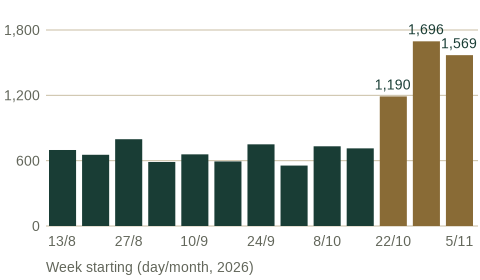
- 11,697 new games in thirteen weeks. Since late October the weekly count has roughly doubled.
- For games four to fourteen weeks old, the median is 3 reviews. Only 11.2 % reach 100 reviews and 2.5 % reach 1,000.
- Price tracks success closely: 3.4 % of games under $5 reach 100 reviews, against 53 % of games at $20 and more.
- 48 % of last week's releases disclose generative AI. Those games reach 100 reviews less than half as often.
- 57 % are a developer's first game on Steam.
- On itch.io, 13,326 games appeared in one week. Only 7 % of them cost money.
1. The flood got bigger in late October
From mid-August to mid-October, Steam received 550 to 800 new games a week. Then it jumped: 1,190 in the week of 22 October, 1,696 the week after, 1,569 in the week to 11 November.
We do not know yet why. It may be a seasonal wave before the holidays, a one-off batch, or a lasting change. The weekly run will tell us within a month.
2. Most new games stay almost invisible
A fresh release has had no time to collect reviews, so for success we look only at games that have been out between four and fourteen weeks: 6,462 of them.
- Median: 3 reviews.
- 26.5 % have none at all.
- 35 % reach 10 reviews, 11.2 % reach 100 and 2.5 % reach 1,000.
Steam does not publish sales. A common rule of thumb multiplies reviews by about 30, and published estimates range from roughly 20 to 60. With that very rough lens, the typical new game sells around a hundred copies, and 100 reviews means something like 3,000.
Games tagged Indie do worse than the rest (8.7 % reach 100 reviews, against 15.1 %), and so do debuts (8.8 %, against 14.4 % for developers who already have a game on Steam).
3. Price is the strongest signal we found
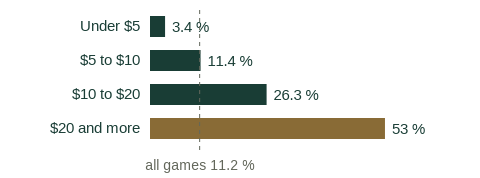
This is correlation, not a pricing tip. A $25 game is usually a bigger project from a bigger team with a marketing budget, and the price is how it signals that. Raising the price of a small game will not buy it the same curve. What the chart does say is that the cheap end of the store is the most crowded and the least noticed: 2,734 of the mature games cost under $5, and only 3.4 % of them got to 100 reviews.
4. Genre matters, and the small-idea genres struggle
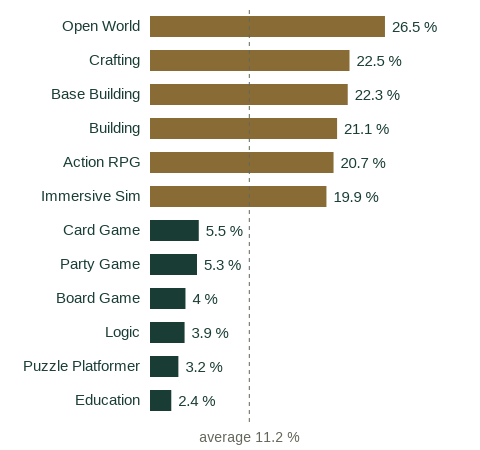
The top of the list is about systems you live in: open worlds, crafting, building a base. The bottom is about small, self-contained ideas: logic, board and card games, party games, education. Puzzle overall sits at 7.5 %, simulation at 15.8 %.
For us this was the most useful chart. Most of our games are exactly the small-idea kind, and on Steam that kind is the hardest to get noticed. In a browser, with no install and no price, a puzzle only has to be good for a minute to get played.
5. The small hits right now are incremental games
We also listed the fifteen small games with the most reviews in their first month: indie, self-published, paid, $15 or less. Eight of them are tagged Incremental. Examples: Moon Sweepers (7,995 reviews in under three weeks, $8.99, a debut), Can 'Em All (2,726 reviews, 97 % positive), Potato Please (2,045) and One Million Coins ($2.49, 1,394 reviews). Across the mature cohort, incremental games reach 100 reviews 15.3 % of the time, above the average.
Fifteen games are a thin sample, so treat this as a trend to watch, not a law. It does make us want to finish our own idle game, Datacenter.
6. Half of new games disclose AI, and they do worse
Steam asks developers to disclose generative AI on the store page. In the latest week, 48 % of new releases did. We read a sample of the disclosure texts: they describe real use (art, voices, music, translations, code). One caution: 56 games share the identical sentence Help in creating images
, which looks like one publisher's batch.
Among mature games, those with an AI disclosure reach 100 reviews in 6.1 % of cases, those without in 15.1 %. The median is 2 reviews against 6. Again, correlation only: disclosing games are cheaper (median $4.99 against $5.99) and more often small indie projects, which already do worse. The data cannot tell whether players avoid AI or whether AI is simply more common in the crowded low end.
A disclosure is also only what developers choose to write. Code written with an AI assistant, for example, does not have to be disclosed at all. This site is made with AI help, as the workshop page explains.
7. itch.io is a different planet
In the seven days to 11 November, 13,326 new games appeared on itch.io, many of them game-jam entries. Only 917 (7 %) cost money. The culture shows in the tags: 4,109 new games mark themselves no-ai, while only 119 use ai-generated. Both tags are self-applied.
The top-sellers list leans on visual novels and simulations, which together hold 17 of its 36 places, at a median price of $5.99. itch does not publish sales or downloads, so beyond counts and rankings there is little to measure.
What we take from it
- Browser stays our default for small ideas. The genres we like making are the ones Steam buries.
- If we ever ship on Steam, it should be a game with a world or a system to live in, priced like a real project, not a $3 experiment.
- Small incremental games are a real lane worth testing.
- We will keep measuring. The collector runs every week and we will post an update when there is a month of new data.
How we measured
Steam data comes from Steam's public Web API (IStoreBrowseService for game details, reviews, tags and prices; player counts and top-seller charts from the same API), plus the public store search for new releases, each game's store page for the AI disclosure, and a developer search for how many games they have. Requests are paced at about one every 1.5 seconds with an honest user agent. itch.io data comes from the public last-7-days listings and the top-seller feeds.
The window covers 11,697 games released from 10 August to 11 November 2026, with 67 junk entries removed. "Success" means the number of Steam reviews, the only public signal that grows with sales. Genre means Steam's user tags. The collection scripts were written with an AI coding agent. The questions, the manual checks and the conclusions are ours.
What we don't know
- Actual sales and revenue. Steam does not publish them. Reviews × 30 is a rough estimate with a wide spread.
- Wishlists. They are not public.
- Hidden AI use. We only see what developers disclose. Games behind an age gate do not show their disclosure to us.
- Adult-only games. Steam hides them from anonymous visitors, so they are missing entirely.
- Who is really a debut. A studio releasing under a new name looks like a newcomer.
- Age bias. Older games in the cohort have had more time to collect reviews. Clean week-by-week comparisons need our own history, which starts now.
- Why releases doubled from late October.
Small games, no install.
Everything on 7ax.fun runs in the browser, free and without an account. Start with WANGAN, an endless night ride on a Tokyo expressway, and tell us what to measure next.