Datacenter
A free idle simulation about the physical side of artificial intelligence. You start with one junk GPU rig in a garage and grow it into a megawatt AI compute operation, selling tokens to increasingly shady clients. Every rack needs electricity, every watt needs cooling, and the game keeps a running total of the litres of water your cooling has evaporated.
About
Datacenter is for anyone who likes number-go-up games and has wondered what an AI answer actually costs in power and water. A session runs in short bursts: tap, buy, wait, rebalance. There is no install, no account and no launcher, and it works on a phone.
What sets it apart from a plain clicker is that growth has two physical bills. Cooling systems are rated with the same two metrics real operators report, PUE for energy overhead and WUE for water. The option that is cheapest on electricity is usually the thirstiest, and the water you evaporate dries out the local aquifer, which brings higher water prices and, eventually, protests at the gate.
How to play
- Starter checklist. The bar above the tabs shows one goal at a time, seven in all, from your first taps to 1,000 TF of compute. Each finished step pays a cash bonus and introduces the next system.
- Overclock tap. Tap the amber button on the scene for a quick burst of cash. It is how the garage pays for its second rig.
- Racks. Buy hardware from a junk RTX rig up to a quantum photonic vault. Each unit adds compute (TF) and power draw (kW), and each purchase raises the next price.
- Power. Your racks plus cooling must stay under grid capacity. Go over and the racks are throttled in a brownout. Expand from a 220 V breaker to substations, a gas peaker, a solar contract and a small modular reactor.
- Cooling. Switch between six systems, from an open window and a fan to sea-floor pods. Lower PUE saves electricity; higher WUE costs water. Systems you have bought stay unlocked.
- Contracts. Better-paying clients unlock at $10,000, $100,000, $1 million and $15 million of lifetime earnings and sign on by themselves. Your price per million tokens is the average of all active contracts, so pausing cheap clients raises it.
- Aquifer stress. Evaporated water raises the stress meter, which makes water dearer. Above 70 % farmers may picket your gates. Lobbying the water board lowers stress by 25 points; it costs $5,000 plus $500 for every point of stress.
- Travel. Relocate to Dublin, the Arizona desert or an Icelandic fjord. A move resets your racks and grid but gives a permanent +25 % compute bonus. Each location changes water cost, ambient heat and how sensitive the neighbours are.
- Random events (AI hype surges, heatwaves, brownouts) change prices for a few seconds. The SFX button switches the 8-bit sound off.
Quick facts
- Type
- Idle simulation, management, tycoon
- Players
- 1, one endless session with relocation (prestige)
- Data
- Real metrics (PUE, WUE) with game-tuned values; sourced reference figures below
- Controls
- Mouse or touch
- Devices
- Desktop, tablet and phone browsers
- Price
- Free, no install, no account
- Language
- English
- Graphics & sound
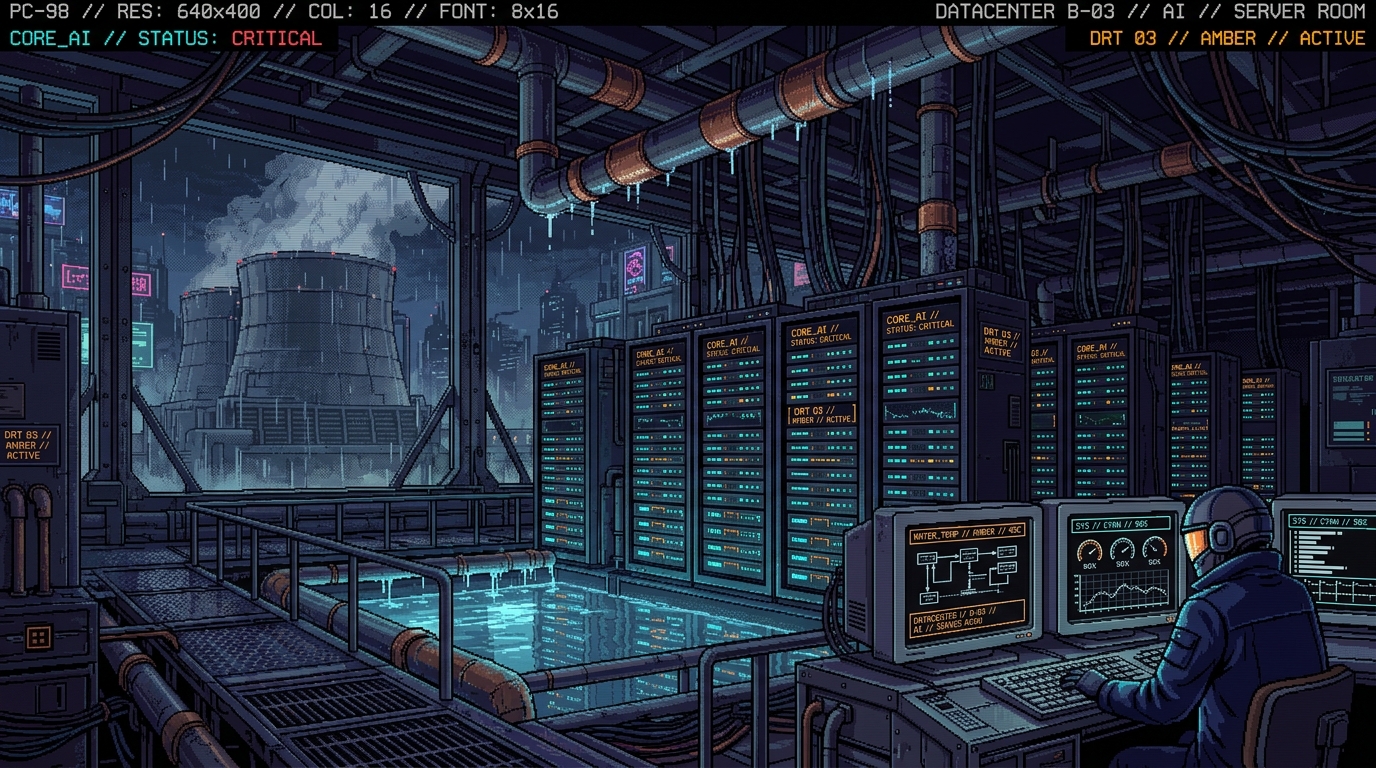
- AI-generated 16-bit pixel art in a PC-98 style, animated with a canvas overlay; 8-bit sound synthesised live with the Web Audio API
- Made by
- Zdenek Petrak (mucker.cz) with AI-assisted coding
- Content reviewed
Methodology: power and water in real AI data centres
PUE (power usage effectiveness) is the total energy a facility uses divided by the energy that reaches the IT equipment. A PUE of 1.5 means that for every kilowatt-hour of computing, another half goes to cooling, power conversion and lighting. WUE (water usage effectiveness), introduced by The Green Grid in 2011, is the annual site water use in litres divided by IT energy in kilowatt-hours. Air-cooled sites can sit near zero; evaporative cooling, which throws heat away by evaporating water, is very efficient on electricity but runs at roughly 1–2.5 L/kWh.
| Reference point | Value |
|---|---|
| Industry average PUE, Uptime Institute survey 2024 | 1.56 |
| Google data centre fleet, trailing twelve months 2024 | PUE 1.09 |
| Microsoft fleet average, fiscal year 2024 | WUE 0.30 L/kWh (0.49 in 2021) |
| US data centres, share of national electricity 2023 (LBNL) | 4.4 % (176 TWh); 6.7–12 % projected for 2028 |
| Irish data centres, share of metered electricity 2024 (CSO) | 22 % (5 % in 2015) |
| Training GPT-3 in US data centres, on-site evaporation (estimate, Li et al.) | about 700,000 L |
The same study estimates that a medium-length conversation of roughly 10–50 answers costs about half a litre of water once the water used to generate the electricity is included. It is a preprint with wide error bars, not a measurement, but it is why the game counts litres. Microsoft says its data-centre designs since August 2024 use closed-loop, chip-level cooling that needs no evaporated water, at the price of slightly higher energy use. That is the same PUE-for-WUE trade the Cooling tab asks you to make.
How the game simplifies
- The cooling tiers mirror real families (room air conditioning, evaporative towers, direct-to-chip cold plates, immersion tanks, sea-floor modules in the spirit of Microsoft's Project Natick). Their PUE and WUE values are rounded and exaggerated so that each choice feels different.
- Real WUE divides water by IT energy. The game applies its WUE only to the cooling overhead (the part of PUE above 1.0) and then multiplies it by a location factor, so its litre counter is a game score, not an estimate of a real facility.
- Token output (50,000 tokens per second per TFLOPS), token prices, electricity at $120/MWh, water at $4.50 per 1,000 L, aquifer stress, protests and lobbying are game mechanics, not market data.
- The four locations name real data-centre regions: Ashburn's Data Center Alley in Virginia, Dublin's strained grid, the drought-hit Sonoran Desert and cool, geothermal Iceland. Their multipliers are invented.
- Hardware names nod to real accelerator generations, but their compute and power figures are scaled for gameplay.
From the operator's log
The Black-Budget Autonomous Defense Grid contract never names its client. Its invoices are stamped Sub-04, a cryo-server block on level B9 beneath the Zaibatsu tower. The tower's elevator panel stops at B4. The invoices clear anyway.
FAQ
What do PUE and WUE mean in the game?
PUE (power usage effectiveness) is total facility energy divided by the energy used by the IT equipment; 1.0 would mean zero overhead. WUE (water usage effectiveness) is litres of water per kilowatt-hour. Every cooling system in the game has both numbers, and the cheapest one on electricity is usually the thirstiest.
Are the water numbers in the game real?
No. The game uses real metrics and plausible orders of magnitude, but its cooling coefficients, location multipliers, token prices and events are tuned for play. The Methodology section above lists real reference values with sources.
Why did my compute output drop?
Your racks plus cooling are drawing more power than the grid can supply, so the racks are throttled. Buy more grid capacity in the Power tab or switch to a cooling system with a lower PUE.
Is my progress saved?
Yes. Progress is saved in your browser's local storage on this device. While the page is closed your racks keep running for up to 24 hours, so you come back to new earnings and more evaporated water. The New game button below the tabs starts over. There is no account and nothing is sent to a server.
Does it work on a phone?
Yes. Everything is tapped, so the game works with a mouse on desktop or a finger on a phone or tablet.
Limits
Datacenter is a satire with real units, not a calculator. It does not model the water used to generate electricity, seasonal weather, water recycling, heat reuse or the hardware supply chain, and the balance has not been tuned against any real business. Use the sources above, not the in-game counter, for any real-world figure.